Getting dirty with CUDA
Jan 18 2009, 09:48
I've finally been getting around to analyzing the MOST observations of σ Ori E. These span 3 weeks and comprise around 25,000 individual photometric measurements — a very impressive dataset. I'm using the CLEAN algorithm (Roberts et al. 1987) to derive the Fourier spectrum; the usual Fast Fourier Transform (FFT) approach can't be used, because the time sampling isn't uniform. The first part of the algorithm involves calculating the dirty spectrum, and can be quite computationally expensive — typically scaling as N^2. So, partly as a learning exercise, I've coded up a CUDA version to run on the new Tesla unit inside Tedesco.
Initial results seem quite impressive; it takes around 50 milliseconds 60 seconds to calculate the dirty spectrum for the whole MOST dataset. There are still a few accuracy issues to be addressed, but using the Tesla looks like a very promising approach to analyzing large time-series observations efficiently.
David Cohen is visiting
Jan 13 2009, 11:41
David Cohen is visiting for a few days, having flown over from Swarthmore College on Sunday. We're working on a variety of topics, including modeling the X-ray line profiles of porous massive-star winds, and investigating the two new magnetic B stars discovered by Petit et al (2008). It seems one of these stars may be a helium-strong star, like σ Ori E; and both of them show measurable X-ray emission.
Tesla C1060 installed
Jan 6 2009, 23:00
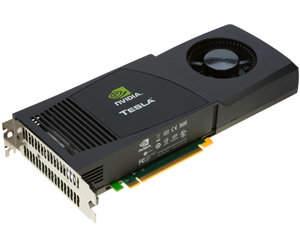
Through their Professor Partnership Program, NVIDIA have very kindly lent me a Tesla C1060 Computing Processor This is basically a graphics card without the usual monitor socket; it contains 240 separate cores optimized for SIMT parallel computation.
My plan is to use the Tesla to speed up interpolation of specific intensities in pre-computed grids (although there are other potential applications that are catching my eye). After some creativity with power cables (the beast requires 2 extra PCI Express power connections), it is now installed in tedesco, the 8-core workstation under my desk. Preliminary benchmarks indicate a bilinear interpolation throughput of around 19 billion interpolations per second. Which is nice.
Website goes live
Jan 6 2009, 22:00
After a week or so spent hacking around with PHP and MySQL, I've finally got this website in a state where it can go live and I can start adding content. Voila, you are reading the very first post in the news/home page section.