Research Interests
Current Research
Stellar Waves & Oscillations

As fluids, stars support a variety of propagating disturbances that take the form of traveling waves when localized, or standing waves (also known as oscillations or pulsations) when global. At the surface of a star, these disturbances cause fluctuations in the star's brightness and color that can be measured via time-series photometry and spectroscopy. Analyzing these measurements can in turn shed light on the internal structure of the star — the discipline of asteroseismology.
Starting with my PhD thesis, I've been studying waves and oscillations in stars for almost three decades, primarily from a theoretical and computational perspective. My highest-profile work has been the development of an open-source stellar oscillation code, GYRE, that predicts the oscillation-mode frequencies and wavefunctions of an input stellar model (see Townsend & Teitler 2013). GYRE is used by hundreds of researchers worldwide, and continues to be actively developed by my Mad Star group. Enhancements since its initial release include
- the ability to model non-adiabatic oscillations (see Townsend et al. 2018).
- integration into MESA (see below).
- a new contour-mapping approach for finding modes (see Goldstein & Townsend 2020).
- support for modeling tides (see below).
Stellar Structure & Evolution

Developing a foundational understanding of the structure and evolution of stars is arguably the crown jewel of 20th-century Astrophysics. However, there are still many areas where the details — both coarse and fine — need to be figured out.
Over the past decade, much progress has been driven by MESA (Modules for Experiments in Stellar Astrophysics), an open-source software instrument for solving the coupled system of equations governing quasi-1D stellar structure and evolution (see Paxton et al. 2011). Since its first public release, MESA has been adopted by over a thousand researchers worldwide to explore ideas at and beyond the cutting edge of stellar astrophysics.
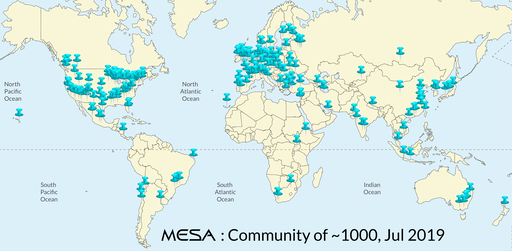
I've been involved in the MESA project since soon after its inception; my contributions include
- developing and maintaining the MESA software development kit (SDK) (introduced in Appendix C of Paxton et al. 2013)
- integrating the GYRE oscillation code (above) into MESA (described in Section 3 of Paxton et al. 2015)
- with Anne Thoul, developing new 'predictive mixing' and 'convective premixing' schemes for handling convective boundaries in MESA (described in Section 2 of Paxton et al. 2018 and Section 5 of Paxton et al. 2019, respectively)
- rebuilding MESA's atmosphere (atm) module to improve accuracy and flexibility (to be described in an upcoming paper)
Stellar & Planetary Tides
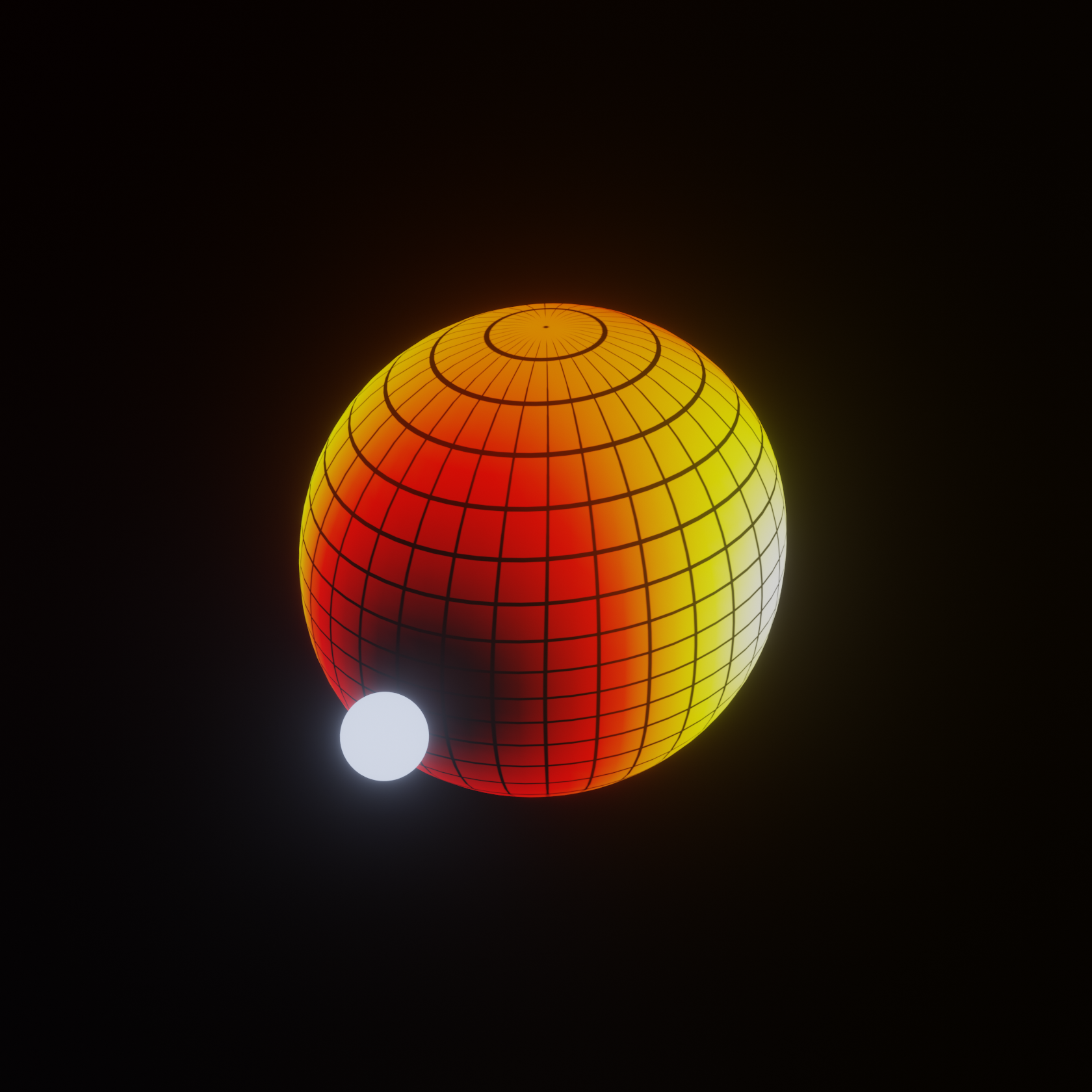
Visualization from a GYRE simulation of a heartbeat system. This is a single frame from the movie linked in the text.
As a spin-off of my work on stellar oscillations, I've recently become interested in stellar and planetary tides — the periodic distortions caused by the gravitational field of a nearby companion object. Tides can be viewed as an instance of forced oscillations, and much of the formalism for tides carries over from the study of stellar oscillations.
With this in mind, I recently extended GYRE so that it can model tides. These new capabilities are described in Sun et al. (2023) and Townsend & Sun (2023), and I have a number of projects underway that use them to model tides in binary star systems and star-planet systems (see, e.g., Narayan et al. 2026).
Here is a movie visualization produced from a GYRE simulation of a heartbeat system (an eccentric binary whose light curve resembles the human heartbeat). The orbital separation between the primary (red) and secondary (white) stars has been artificially decreased, and the amplitude of the tidal distortions in the primary increased, in order to make the tidal effects clear. However, the spatial and temporal structure of the distortions come directly from GYRE, and reveal the typical characteristics of tides in eccentric binaries: a large tidal bulge visible near periastron (the "equilibrium" tide), and a complex wave field visible throughout the orbital cycle ("dynamical" tides).
Scientific Computation
In addition to the focused research described above, I'm often involved in offshoot projects arising from my 40-year interest in scientific computation. Highlights include
- creating the new MSG (Multidimensional Spectral Grids project, a software and data infrastructure for interpolating stellar spectra and photometric colors (see Townsend & Lopez 2022)
- implementing the Lomb-Scargle periodogram on graphics processing units (see Townsend 2009)
- developing a new exact algorithm for radiative coooling in hydro codes (see Townsend 2010)
Older Stuff
Here, I mention some projects I've been involved in over the years. These are no longer my main research focus, but I still dabble in them from time to time.
Circumstellar Magnetospheres
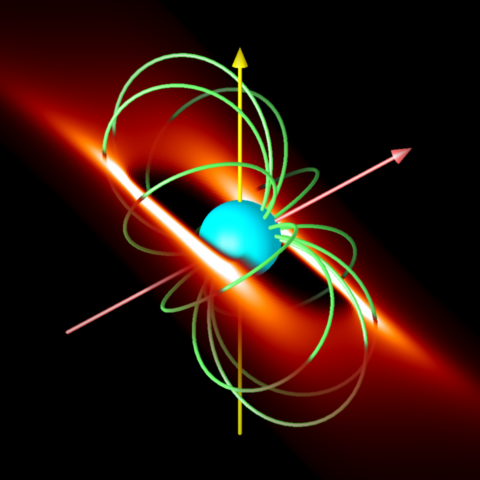
A simulation of the circumstellar matter distribution of σ Ori E, as predicted by the Rigidly Rotating Magnetosphere model.
Unexpectedly (from a dynamo standpoint), strong (~kG) fields are observed in a number of massive stars, including the helium-strong chemically peculiar stars (e.g., σ Ori E), the helium-weak stars (e.g., 36 Lyn) and a few more-massive O-type stars (e.g., θ1 Ori C). My past research has focused on creating models for the magnetospheres of these stars — circumstellar environments where the dynamics of wind outflows are significantly affected by the presence of the magnetic field. These include
- the Rigidly Rotating Magnetosphere (RRM) model (see Townsend & Owocki 2004)
- the Rigid-Field Hydrodynamics (RFHD) model (see Townsend, Owocki & ud-Doula 2007)
- the Analytical Dynamical Magnetosphere (ADM) model (see Owocki et al. 2016)
I've also contributed toward our observational exploration of these systems, in particular leading the team that discovered the spin-down of σ Ori E — arguably the first direct measurement of magnetic braking in a main-sequence star (see Townsend et al. 2011).