Back from the mountain
Feb 3 2009, 23:23
Fernando and I are now back from Kitt Peak, after a largely successful observing run. In addition to monitoring V* NU Ori and V* LP Ori (the two magnetic stars discovered by Petit et al. 2008), we had a look at FN CMa for a night, to see if we could get a handle on some weird variability that Thomas Rivinius told me about recently. We'll have to see what the data show.
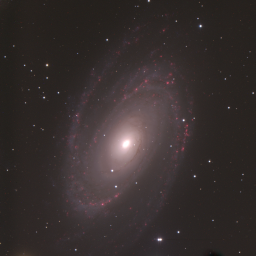
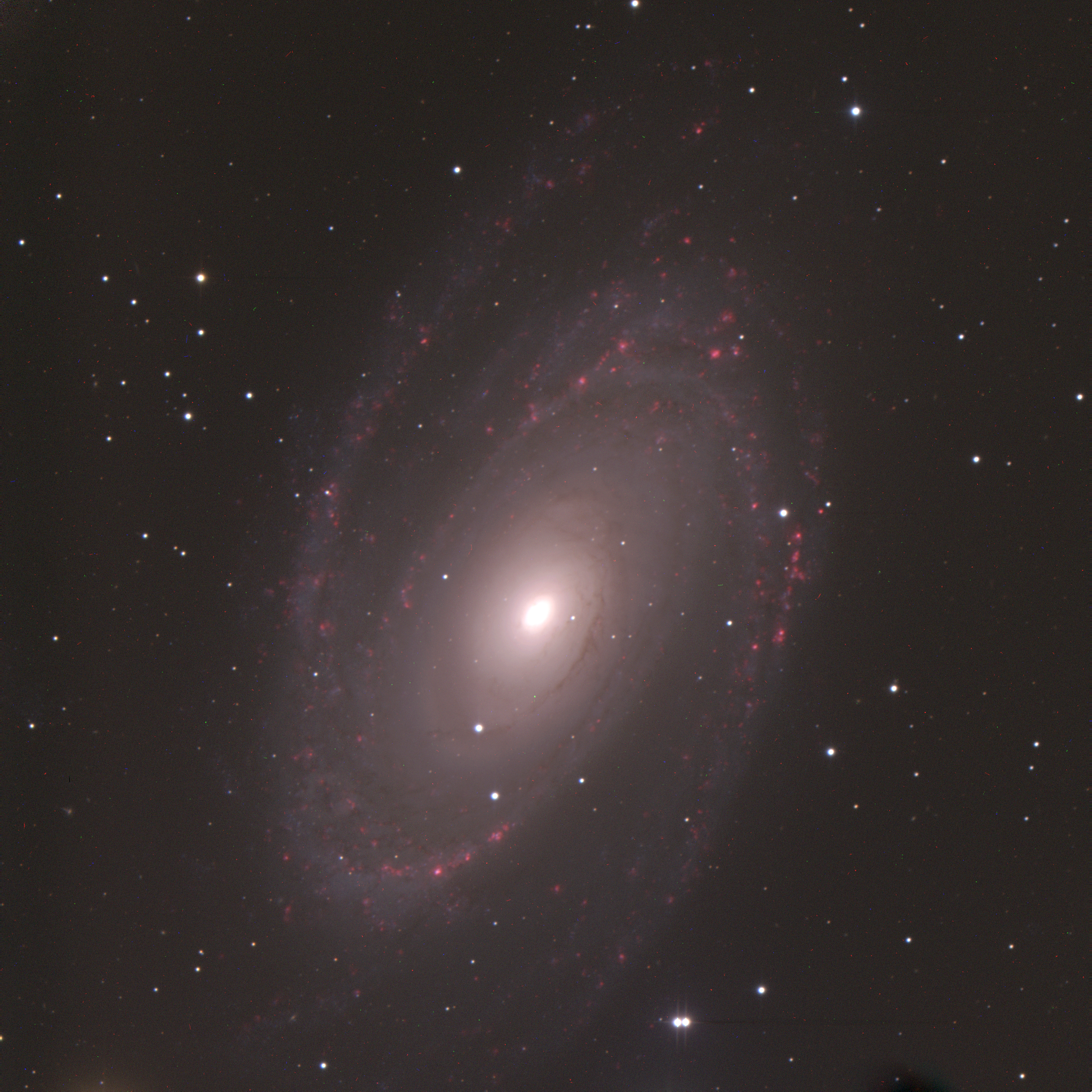
Because our science targets were in Orion and Canis Majoris, they set around 2:30am, three and a half hours before sunrise. We used some of this 'spare' time to undertake service observations, but for the rest we went after some pretty galaxies. The image to the right is a composite of M81, based on the Johnson BVR filters plus an Hα filter. The latter very nicely picks out the star-forming regions in the spiral arms of the galaxy. A full-sized version of the image can be grabbed here; kudos to John Barentine for assembling the image from its constituent parts while we were up on the mountain. Stay tuned for similar images of M82 and M104.
A theorist goes observing
Jan 31 2009, 07:39
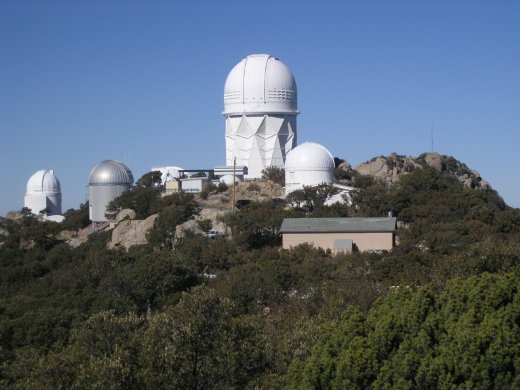
Right now, I'm sat with Fernando Cardoso in the control room of the WIYN 0.9m telescope at Kitt Peak National Observatory. Although most of my research is theoretically oriented, I try to remain in touch with the experimental side of things — which leads me now and then to go off on an observing trip. This particular adventure came about due to 6 unscheduled nights on the 0.9m.
Fernando and I have mostly been undertaking differential CCD photometry of a couple of massive magnetic stars in Orion: V* NU Ori and V* LP Ori. The fields in these stars were only recently detected (see Petit et al. 2008), and we're looking to see whether the stars show the same sorts of periodic photometric variations as other, similar objects.
First light on Medusa
Jan 24 2009, 10:42
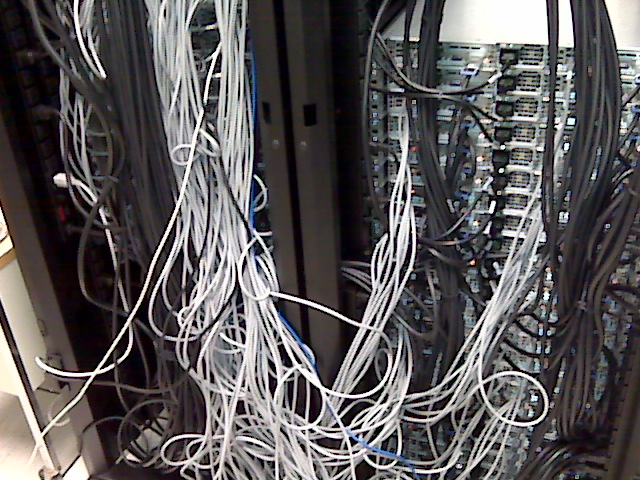
I've just completed my first successful set of calculations on Medusa, the new computer cluster that the Theory Group recently purchased. Medusa comprises 72 nodes of 8 AMD Opteron processors each, linked together with an InfiniBand networking fabric. There have been a few teething problems, but everything seems to be working OK now.
The test calculations involve Monte-Carlo simulation of radiative transfer through the electron-scattering magnetosphere of σ Ori E. I'm trying to reproduce the temporal variations in the star's linear polarization, originally observed by Kemp & Herman (1977). I've made some Stokes IQU images of the simulation results, and strung them together as a movie (AVI; MOV; movie help).
New paper: 'An Exact Integration Scheme for Radiative Cooling in Hydrodynamical Simulations'
Jan 20 2009, 15:19
The paper has just been accepted for publication in the Astrophysical Journal Supplement Series, and will be appearing in the August 2009 issue. It discusses a new method for implementing optically thin radiative cooling in hydro/MHD codes, which constitutes a big improvement over previous approaches. The method came to me when I was figuring out how to speed up cooling in VH-1; I had recently been reading a computer graphics article on speeding up Phong shading using look-up tables, and I realized that a similar approach could be used for the cooling calculation. The beauty of using look-ups is that they're not only fast, they're also exact.
MOST proposal accepted
Jan 19 2009, 12:16
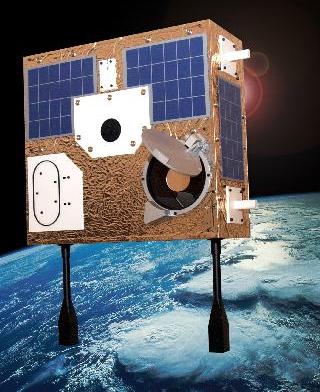
John Monnier informs me that our MOST proposal to observe Altair and Rasalhague has been accepted. These are both rapidly rotating A stars, known from interferometry to be oblate due to the centrifugal force. The objective of the observations is to look for δ Scuti-like pulsations (Altair is already know to pulsate), and to use the pulsations to place constraints on the internal rotation.
This will involve my developing a new pulsation code that can handle differential rotation — quite an undertaking, but something I've been meaning to do for nearly a decade now. The new computer recently purchased by the Theory Group will be the perfect platform on which to run the code; so, all that's required now is a few months of furious programming.
< Newer articles
Older articles >